Turning Industrial Waste Into a Trusted Product
Europe produces millions of tonnes of industrial waste every year - much of it hazardous, most of it still treated as a disposal problem rather than a resource. That's the starting point of Z-ONA4LIFE, a LIFE project that produces a high-value material with applications ranging from gas purification to wastewater treatment. But developing the material is only half the job. A circular product only becomes a marketable product once someone can prove it's safe, consistent, and reliable - and that proof usually takes the form of a standard or a patent.
This is the bottleneck we've had to plan for from early on. Unlike more established industries, circular economy is still a young field, and the standards needed to certify its innovations - confirming, for instance, that a material derived from hazardous waste is safe to use - are often still being written. Many circular economy projects don't know where to start: how to engage with standardisation bodies, , how to structure a patent application, or how to prove to a buyer that their product meets the bar. Without that certification, even the most promising innovation can stall before it ever reaches the market, no matter how sound the science behind it. That's why from the outset of the project, we have been working not only to scientifically demonstrate the performance of our zeolite, but also to generate the evidence needed for its certification and commercialisation, confirming that, despite being derived from waste, it is safe, consistent and reliable - the step that turns a research result into a product a buyer can actually trust.
Taking that story to Berlin
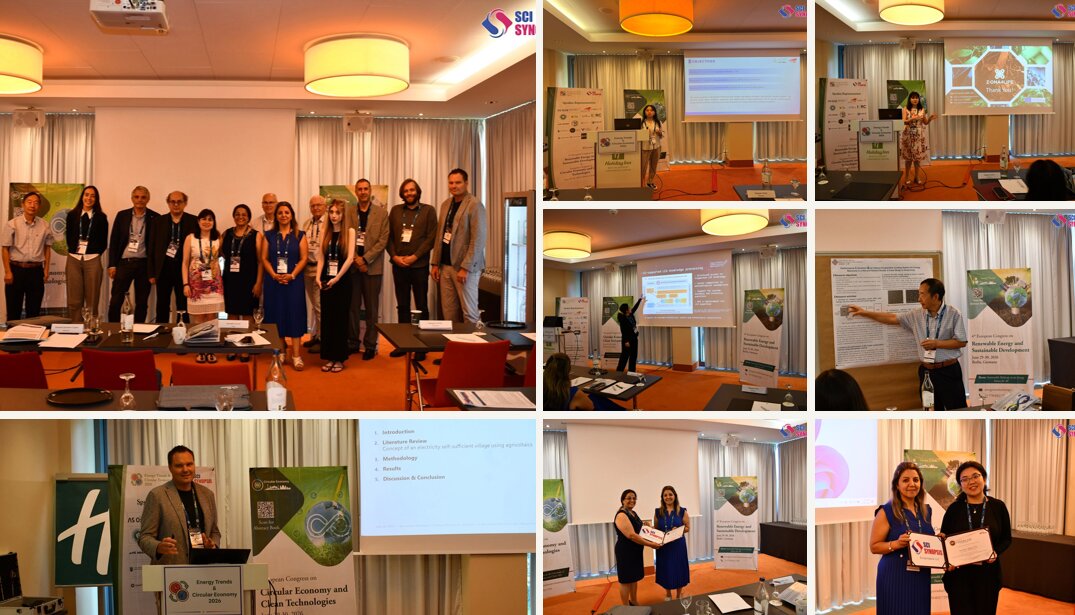
It's also the reason we chose to present Z-ONA4LIFE at the first edition of the European Congress on Circular Economy and Clean Technologies, held in Berlin as part of the wider EU Congress on Renewable Energy and Sustainable Development. Over two days, researchers, professors, and industry experts gathered to present the latest science on circular economy and energy, and one question kept coming up in different forms: once you've developed a circular material or process, how do you actually prove it's ready for the market? It's a question we live with daily, and presenting our abstract there was a chance to introduce Z-ONA4LIFE to a community that had never encountered the project before - and to talk through, openly, where we are on the road to certification.
Building the bridge from lab to market
Getting the science right was never going to be enough on its own. Alongside the patent work, we're testing Z-ONA zeolite in real conditions - treating challenged effluents at a demo plant, purifying gas streams and wastewater, and even recovering the spent zeolite to improve composting processes elsewhere. Each of these steps builds the track record a standard or a certification will eventually need to point to: not just that the material works in principle, but that it performs reliably in the field. Conversations like the ones we had in Berlin are part of that same effort - every new contact who understands what Z-ONA zeolite can do, and asks the right questions about how it's certified, pushes us a little further along that path.
Get involved
If you represent an industrial partner interested in sourcing Z-ONA zeolite, a researcher working on related circular economy challenges, or simply want to stay close to our progress toward the pilot and beyond, we'd like to hear from you.
Subscribe to our newsletter and follow our updates