
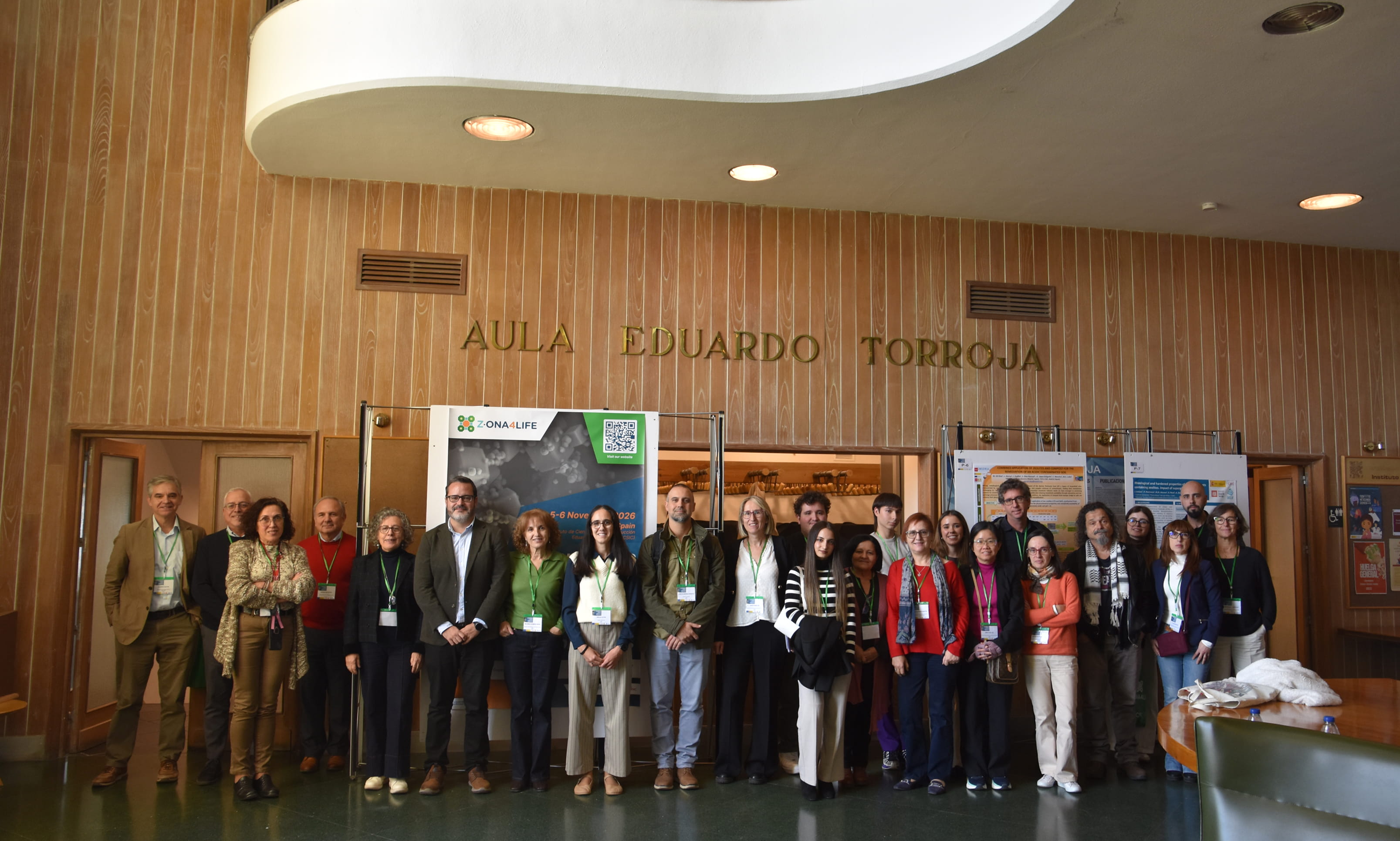
Madrid, ES, November 19, 2026 – On 5 and 6 November 2026, the Second Conference on “Sustainable Zeolites: Advances in Synthesis and Applications” (ZASA 2026) took place at the Instituto de Ciencias de la Construcción Eduardo Torroja (IETcc-CSIC) in Madrid, and online.
Organised by IETcc, in collaboration with Trust-IT Services, the conference was part of the dissemination activities of the Z-ONA4LIFE project. It brought together scientists and industry professionals to share advances in zeolite science, with a strong focus on sustainability.
Download the official Press Release
Event Overview
The conference opened with welcome remarks from Maximina Romero, coordinator of Z-ONA4LIFE (IETcc-CSIC), Enrique Sastre, CSIC Coordinator for the Autonomous Community of Madrid, and Mª Teresa Martín, Technical Deputy Director of IETcc-CSIC. They presented the two days as an opportunity to show how research and innovation can benefit society and protect the planet, and to build new collaborations around the many applications of zeolites.
Over two days, the programme included two invited lectures, 22 oral presentations in five sessions, and a poster session with seven contributions. Speakers came from Spain, Italy, China, Brazil, Croatia, Bulgaria, Mexico and Romania. This was a clear step from the first edition in 2024, which had a national character.
Highlights of the programme included:
- Natural resources as catalyst sources: the invited lecture by Isabel Díaz (ICP-CSIC, President of the Spanish Group of Zeolites) showed how natural mordenite from Cabo de Gata can be transformed into ZSM-5 catalysts for converting methanol into fuels and chemicals, and why life-cycle assessment is essential to judge whether a catalyst is truly sustainable (Itziar Arnaiz, ICP-CSIC).
- Zeolites from waste: Claudia Belviso (CNR) showed that rice husk ash and metallurgical by-products can produce zeolites in only 3 to 6 hours, and that seawater can be used as a synthe-sis medium.
- Faster synthesis: Hedieh Tabatabaeizadeh (University of Torino) presented a titanium-Beta zeolite that crystallises about 17 times faster using a chemical accelerator and seed crystals and Luis Gómez-Hortigüela exposed the synthesis of zeolites under microgravity
- Computational design: Germán Sastre (ITQ-CSIC) y Georgi Vayssilov (Universidad de Sofía) ex-plained how modelling can predict which zeolites form and help design the templates needed to make them, and model the chemical reactions.
- Cleaner water: contributions on removing chromium (VI) (Bruno F.P de Azevedo, Universidad de Pisa), dyes (Magali Ritter, Universidad Federal de Santa Catarina), ammonium (Siaw F. Lee, IETcc-CSIC), and emerging contaminants (Alexandre Diorio, Universidad de Maringá) such as pharmaceuticals, using natural, modified and waste-derived zeolites, as well as a zeolite-assisted electrocoagulation process for laundry greywater (Nediljka Vukojević Medvidović, Universidad de Split).
- Cleaner air and energy: zeolite membranes for producing dimethyl ether, a low-carbon diesel alternative (Adele Brunetti, ITM-CNR), catalysts for ship and car emissions (Birong Miao, Dalian Maritime University; Luigi Calabrese, Universidad de Messina), greenhouse gas (Eva Díaz, Uni-versidad de Oviedo), and membranes for CO₂ separation (Lucas Güemes, INMA-CSIC).
- Construction: lightweight aggregates made from industrial waste (Noelia Cotón, UAM), syn-thetic zeolites as partial cement replacements (Pedro Carballosa, IETcc-CSIC), and caesium immobilisation for radioactive waste management (Nuria Husillos, IETcc-CSIC).
- Market exploring: Norberto Vidaña (Progresum International S.A.), and Rita Giuffrida and Ana Ivaschiv (Trust-IT) presented a study on the zeolite market in North America and Europe.
Z-ONA4LIFE results in the spotlight
Several contributions presented results obtained within the project. The IETcc-CSIC team presented the results of using zeolite produced from aluminium salt slag and glass waste to remove ammonium from real wastewater. In collaboration with the Federal University of Santa Catarina, the team presented results obtained using a NaP zeolite manufactured from salt slag and rice husk ash, which succeeded in removing more than 99% of a textile dye and kept more than 97% efficiency after four reuse cycles. Furthermore, it was demonstrated that the synthetic zeolites produced can be used to manufacture more sustainable mortar.
Closing remarks
In the closing session, Maximina Romero and José Luis García-Calvo (Scientific deputy director of IETCC-CSIC) thanked speakers and participants and highlighted the variety of contributions presented, including applications of zeolites from sustainable energy to circular economy. They also noted how this second edition of the conference attracted greater international participation and expressed hope for a third edition.
“The significant international participation and high-quality contributions presented reflect the increasing interest in using sustainable zeolites to address environmental challenges. This conference has demonstrated the significant potential of transforming industrial waste into high-value materials with real applications. At Z-ONA4LIFE, we are working to bring these innovations to market and contribute to a more circular and sustainable economy.”
Download the 2nd Conference Book of Abstracts
The abstracts selected for the conference reflected the breadth of current zeolite research, from synthesis routes based on natural and waste-derived raw materials to applications in water treatment, catalysis, gas separation and construction.
We have compiled this book of abstracts to share the diverse approaches and findings presented over the two days, and to give visibility to the work of the authors who contributed to the conference.
Download the Book of Abstracts
Bringing sustainable zeolites closer to the market
With Z-ONA4LIFE, the project continues to move from the laboratory towards industrial reality. With the first pilot plant nearing completion at Alusigma’s facilities in Gijón and a second demonstration plant being designed for COGERSA (Gijón), the project is showing how hazardous aluminium industry waste can become a valuable secondary raw material, with the goal of bringing Z-ONA zeolites to the market, starting in Spain and expanding to other regions and sectors.
On the second day, Trust-IT Services presented the main findings of the project’s expert workshop and open consultation on the barriers to industrial adoption of waste-derived zeolites, with respondents from across Europe and also from Canada and Australia. The presentation placed Z-ONA4LIFE between the pilot demonstration and industrial validation stages of a four-stage adoption pathway. The full findings, including the policy recommendations, are available in the Z-ONA4LIFE Blueprint.
This second edition confirmed the growing interest in sustainable zeolites and the wide range of applications. By bringing together researchers and industry representatives, the conference showed how zeolites can support the Sustainable Development Goals and become a driving force for better practice in waste management.
----------
The conference was sponsored by Labotronic and Zeocel Italia.
If you would like to get in contact with us, feel free to reach out to:
- Maximina Romero, IETcc-CSIC (Z-ONA4LIFE Project Coordinator) mromero@ietcc.csic.es
- Rita Giuffrida, Trust-IT Services (Z-ONA4LIFE Communication Leader) r.giuffrida@trust-itservices.com